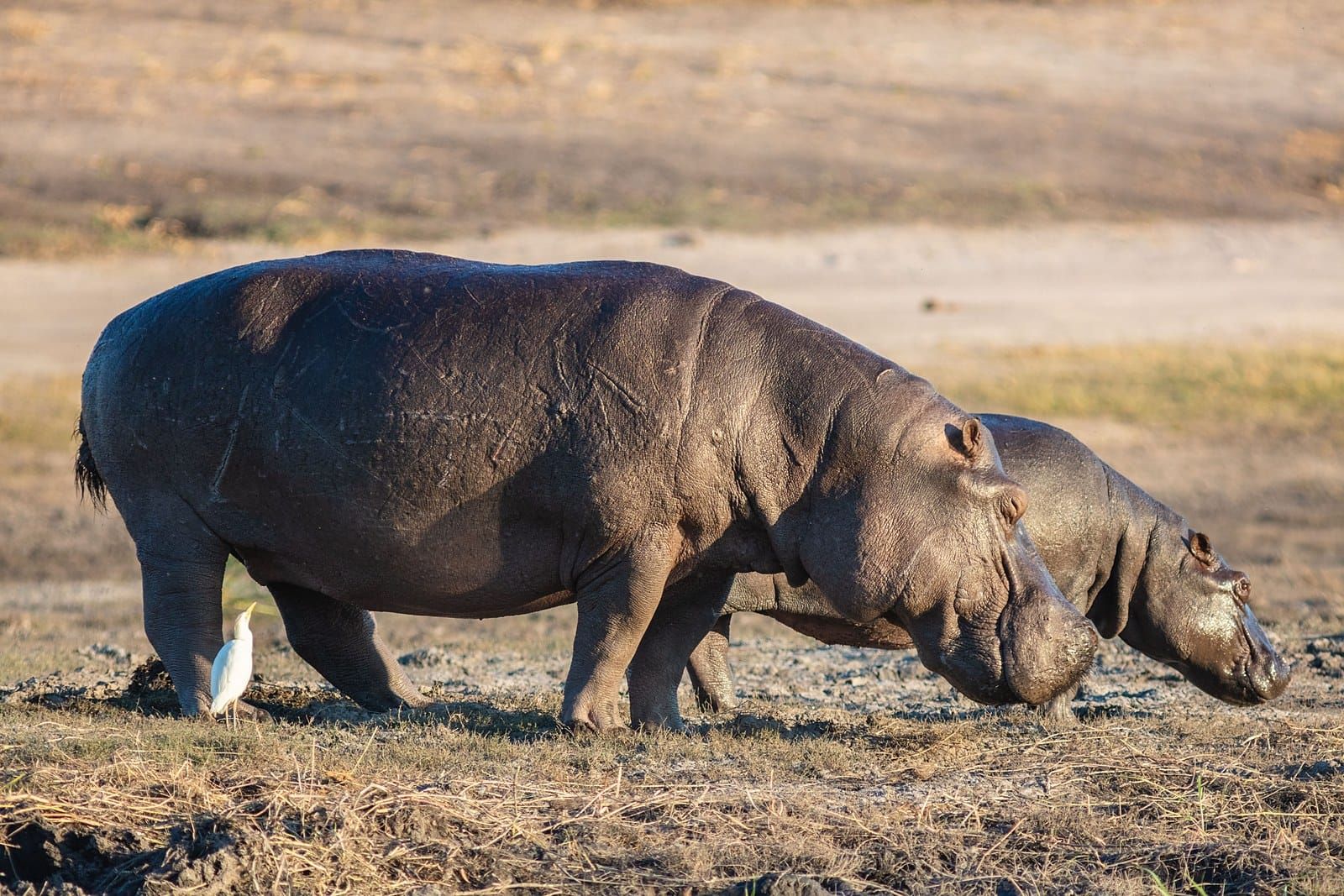
Start with the sweat, which is not sweat and is not red. A hippo's skin gives off a clear oily fluid that turns red within minutes and brown by the afternoon, and in 2004 Kimiko Hashimoto and colleagues at Kyoto Pharmaceutical University worked out why: two pigments they named hipposudoric acid and norhipposudoric acid, which soak up ultraviolet light and stop bacteria growing. A hippo makes its own sunscreen and antiseptic, every day, for free. Then the running. Hippos never gallop, only trot, but John Hutchinson's team at the Royal Veterinary College in London filmed them at full speed in 2024 and found that a hippo in a hurry lifts all four feet off the ground for a fraction of every stride. In the water, though, they cannot swim at all. Their bones are so dense they sink, and they walk and bound along the riverbed in a slow motion gallop, moments with no foot touching the bottom, then rise to breathe. A resting hippo does that every few minutes without waking; the body surfaces on its own.
They also know each other. In the Maputo Special Reserve in Mozambique, Nicolas Mathevon of the University of Saint Etienne played recorded honks to wild hippos in 2022: a familiar voice from their own pod got a calm reply, a neighbour's a louder one, and a stranger's a charge. Hippos know their friends by voice alone. And they are not the night owls the books say. Victoria Inman and Keith Leggett of UNSW Sydney kept the first round the clock watch on wild hippos, in the Okavango and Chobe in Botswana, and reported in December 2025 that they fed for only a quarter of the night and spent hours of the day on land, feeding and basking. Rivers depend on them, too. Jonas Schoelynck of the University of Antwerp found that hippos on Kenya's Mara River carry hundreds of kilograms of silicon a day in from the grasslands, up to three quarters of the river's supply, the mineral the diatoms need that feed everything downstream. Their trails carve channels that let water spread across the wetlands for fish, crocodiles and elephants. Sunscreen chemist, river engineer, occasional flyer, and a friend who knows your voice: that is a hippo, and their closest living relatives, for the record, are whales.
Sources and links
Our short take: drawn from five studies, linked below, each by the scientists named in the story.
- The red sweat of the hippopotamus, Nature, 2004 Hashimoto and colleagues, Kyoto Pharmaceutical University.
- RVC research discovers hippos' ability to become airborne, Royal Veterinary College, 2024 Hutchinson's team.
- Hippos can recognise each other's voices, Africanews, 25 January 2022 Mathevon's playback study, Current Biology.
- Sleeping giants, Journal of Mammalogy, December 2025 Inman and Leggett, UNSW Sydney, Botswana.
- Hippos, the animal silicon pump, Science Advances, May 2019 Schoelynck, University of Antwerp, with the Yale Mara project.