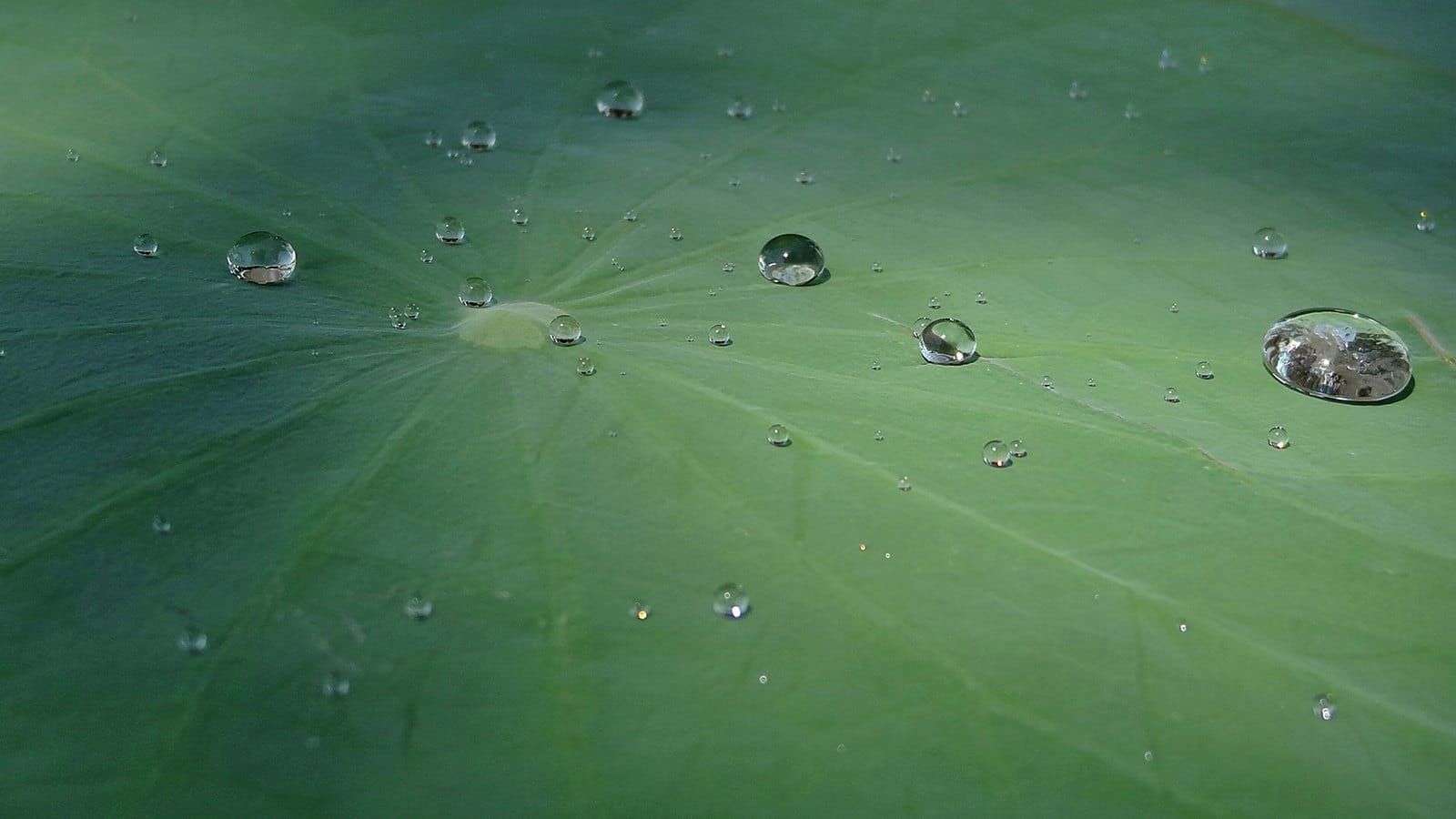
Almost everything white around you, from paint and paper to yoghurt pots, gets its whiteness from titanium dioxide, a mineral pigment mined and milled in enormous quantities, and much of what repels water gets that from PFAS, the family of forever chemicals. Snow needs neither. It is white because countless tiny surfaces scatter light in every direction, and a lotus leaf sheds rain because its surface is rough at a scale too small to see. A team at Kyoto University's Institute for Integrated Cell Material Sciences, led by Professor Easan Sivaniah with Detao Qin as first author, has taught everyday plastics to do both. Light breaks the polymer into fragments, a mild solvent swells it, and a foam of microscopic pores forms through the film, each pore bouncing light like a snowflake, with a lotus leaf roughness on top.
Their paper appeared in Nature on 9 September, with Associate Professor Taiki Yanagishima of Tokyo Metropolitan University and textile researchers at Donghua University in China. They call the method Deep Foam Photolithography, and it prints patterns at around 20,000 dots per inch. What makes it more than a laboratory curiosity is the aim the researchers set themselves, nature's designs at the scale and cost of existing materials, and the fact that the process needs no new specialty chemicals and works with several plastics already on the market. Europe has already stopped using titanium dioxide as a food additive, and forever chemicals are on their way out of coatings around the world, so a white that is only air and plastic, printable in patterns finer than a hair, arrives at exactly the right moment. It is a small, clever thing, learned from snow.
Sources and links
Our short take: the research is described in a Kyoto University release carried by ScienceDaily (10 September 2026) and in the Nature paper linked below. Photograph: Aathavan jaffna, CC BY-SA 3.0.
- White is more than a colour, Kyoto University iCeMS The university's release, 10 September 2026.
- Foaming photopolymers as a high resolution biomimetic printing platform The paper in Nature, 9 September 2026.