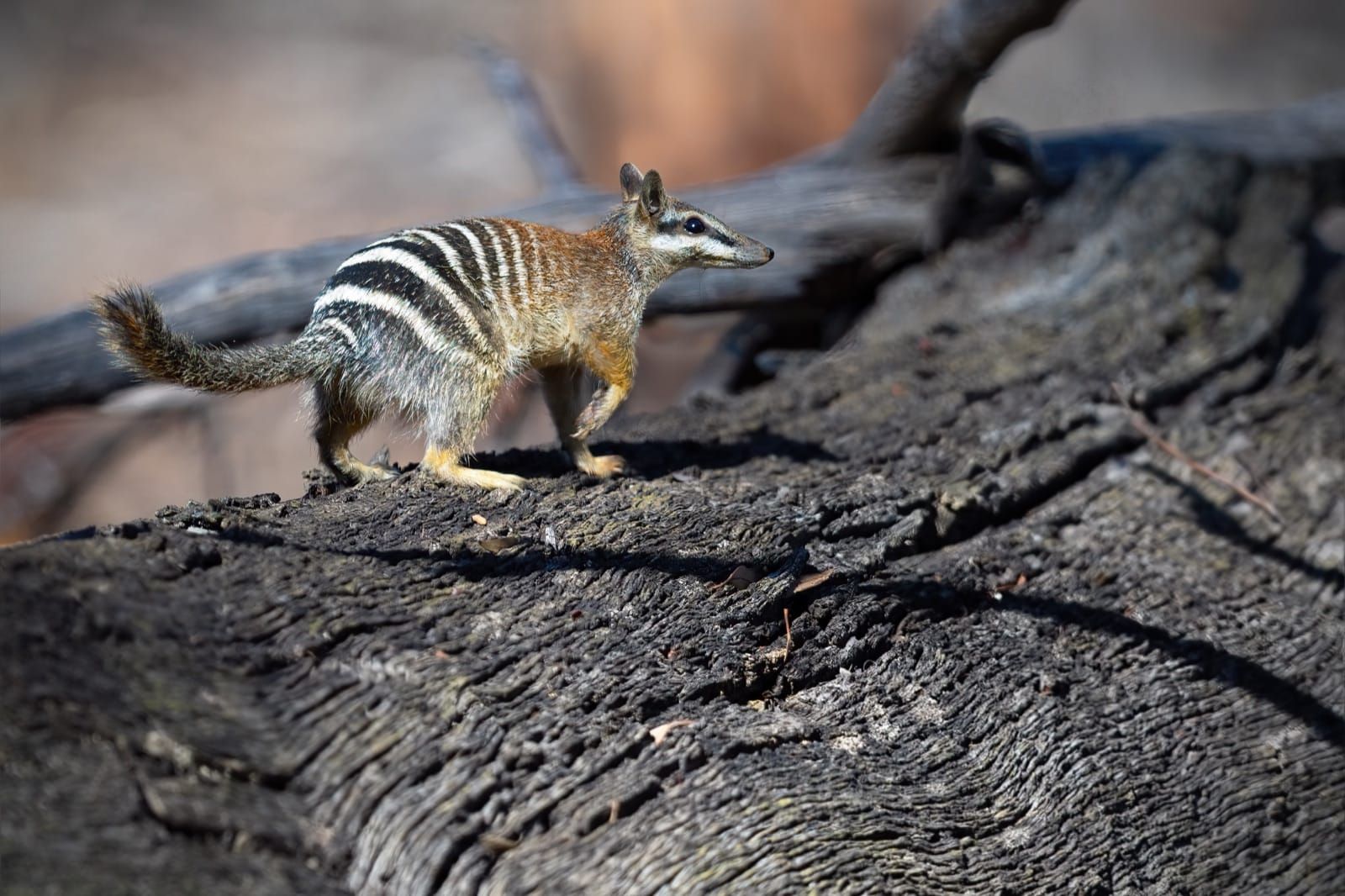
A numbat is a small striped marsupial that eats nothing but termites, Western Australia's animal emblem. By the late 1970s about 300 were left, in two pockets of woodland south east of Perth. On 9 July this year the International Union for Conservation of Nature moved the numbat on its Red List from Endangered to Near Threatened, with mature animals now estimated at 2,000 to 3,000, including at least five new populations in Western Australia, South Australia and New South Wales. Dr Tony Friend of the Department of Biodiversity, Conservation and Attractions has worked on numbats for about forty years, and told Mongabay's Shreya Dasgupta: "The 'downlisting' of the numbat on the IUCN Red List from Endangered to Near Threatened is what we have been working for over the last 40 years!" Perth Zoo's breed for release program has sent 325 zoo born numbats into the bush over close to thirty years, and Harriet Mills, the zoo's science program leader, told ABC News the whole zoo is proud of its part.
Behind the scientists stands a community. Project Numbat, a volunteer run charity in Perth, has put more than $200,000 into numbat work since 2006, including over $10,000 for radio collars and, most recently, $4,400 for collars and tracking flights for four of this year's zoo born numbats before their release. That money comes from bingo nights, quiz nights, a wine fundraiser and a stall of numbat puppets and calendars, and Rob Hemsworth, the zoologist who is the group's president, spends his working weeks on fauna surveys in remote country and his weekends on this. Every few months volunteers drive two hours to Boyagin Nature Reserve to change the batteries in the motion cameras, and each November they walk lines through the bush counting numbat diggings. Further south, at Dryandra Woodland National Park, 171 kilometres from Perth, the Numbat Task Force is Rob McLean, airline worker Sean Van Alphen, power company employee Matthew Willett and John Lawson, caretaker of the Lions Dryandra Woodland Village, named Australian Geographic's Conservationist of the Year in 2018. Each November they join Dr Friend for the official drive survey. In November 2024 that meant six slow circuits, 388 kilometres and 25 numbats seen, about one every 15 kilometres, in a woodland whose whole population was estimated at about 50 animals in 2014.
Everyone involved says the same thing: Near Threatened is a milestone, not a finish line. Numbats live on about 0.04 per cent of the country they once roamed, they remain listed as endangered under Australian law, and the gains hold only with the bush around them kept safe. Project Numbat put it warmly on its own news page: the numbat's recovery shows what is possible when people commit to a species over the long term. This November the cars roll slowly through Dryandra again, eyes on the roadside for a flash of stripes.
Sources and links
Our short take: the full story is by Shreya Dasgupta for Mongabay (10 July 2026) and by Will Corbett and Oliver Peterson for ABC News, ABC Great Southern (12 July 2026), with figures from the IUCN Red List release of 9 July 2026, Project Numbat and the Numbat Task Force survey update on the FAME project page. Photograph: numbat, Myrmecobius fasciatus, Dryandra Woodland, Western Australia, by JJ Harrison, via Wikimedia Commons under CC BY-SA 4.0.
- Once endangered, Australia's numbat is making a hopeful recovery, by Shreya Dasgupta, Mongabay Dr Tony Friend's quote and the five new populations; 10 July 2026.
- Numbat conservation efforts pull native species from brink of extinction, by Will Corbett and Oliver Peterson, ABC News Perth Zoo's 325 releases, Harriet Mills, Australian listing still endangered; 12 July 2026.
- From desert frog to deep sea molluscs, remarkable species at risk, IUCN Red List The release of 9 July 2026: 300 to between 2,000 and 3,000, 0.04 per cent of range, Prof John Woinarski.
- Numbats are bouncing back!, Project Numbat Project Numbat's own news post, 12 July 2026, photo by Flynn Prall.
- Our activities, Project Numbat Radio collars, aerial surveys, Boyagin camera trips, November dig surveys, the $200,000 total.
- Protecting and understanding numbats, FAME Numbat Task Force drive survey update of 21 November 2024: 25 numbats over 388 km, six circuits, 2014 estimate of about 50.
- How a few blokes decided to try and save the numbat, Australian Geographic The four founders of the Numbat Task Force; Conservationist of the Year 2018.
- Numbat steps back from the brink, Australian Wildlife Conservancy Dr Jennifer Anson; the Scotia, Yookamurra, Mt Gibson and Mallee Cliffs populations.
- Photograph on Wikimedia Commons JJ Harrison, CC BY-SA 4.0, https://creativecommons.org/licenses/by-sa/4.0