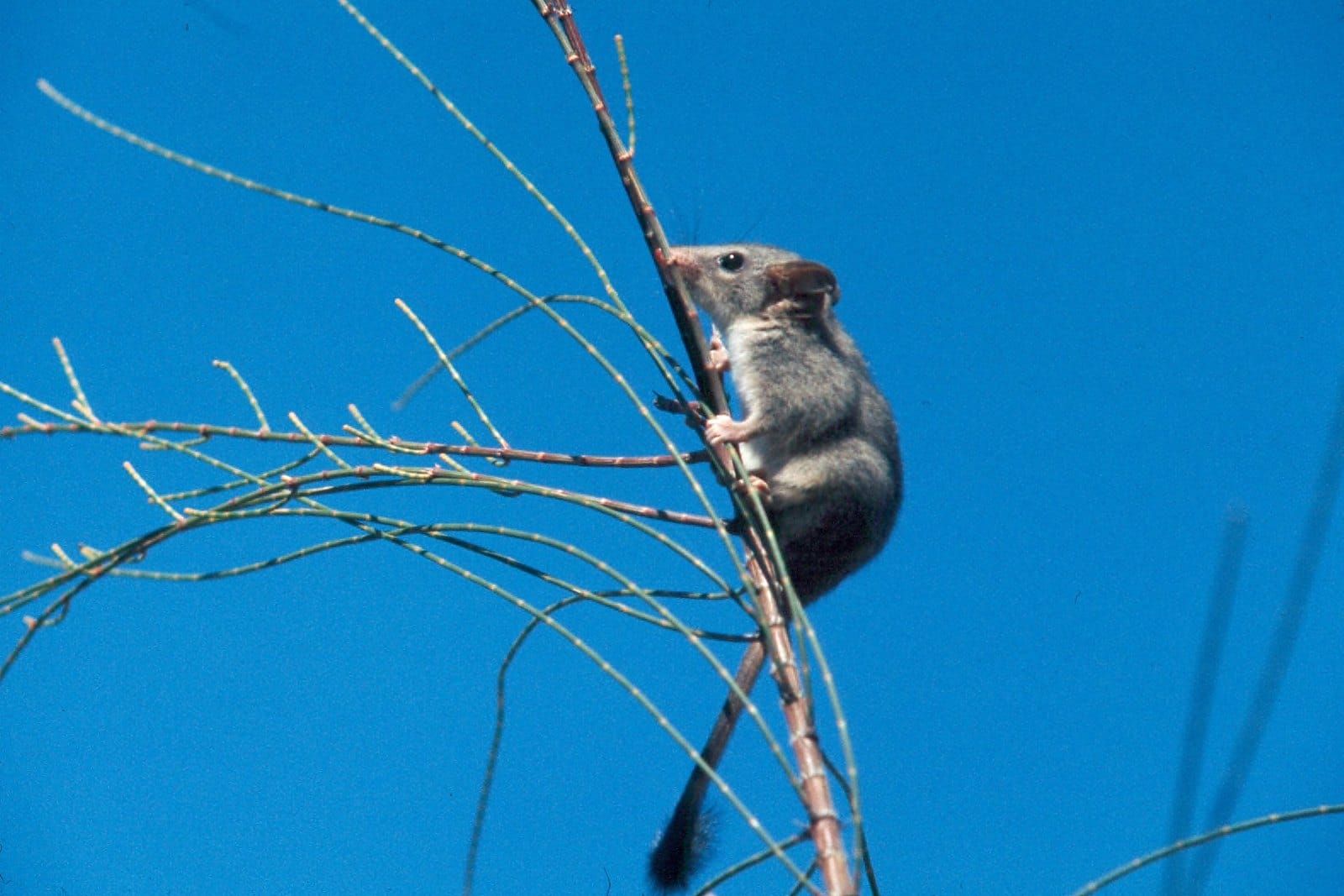
A red tailed phascogale weighs about as much as two fifty cent coins, lives in tree hollows, hunts insects after dark, and carries a rust coloured tail with a brush of black at the tip. Its males live fast and finish young: about eleven months, one breeding season, and done. So a population can drop quickly in a hard year and rise just as quickly in a good one, and this September it rose. During the spring survey at Australian Wildlife Conservancy's Mt Gibson Wildlife Sanctuary, north east of Perth, ecologists caught 48 phascogales inside the 7,800 hectare fenced area where feral cats and foxes are kept out, more than double the 28 caught in 2024 and the most since the species was returned there nine years ago. Field ecologist Aliesha Dodson puts it down to the rain. Only 171 millimetres fell through the drought of 2023 and 2024, then 401 millimetres arrived after June 2024 and another 319 last year, the insects came back, and so did the phascogales.
On the other side of the country the same small animal is writing the same story. In the Gawler Ranges on South Australia's Eyre Peninsula, phascogales released into a safe haven have now bred in the wild for a third year in a row, the mark of a population that has settled in rather than simply survived. Nationally the species is listed as vulnerable, holding on in scattered pockets of the south west and in the sanctuaries and havens that have brought it back to country it had gone from. That is the honest shape of it: a fence and a good season are what these numbers rest on, and a dry year will test them again. But for now, in two states at once, a creature most Australians have never heard of is climbing through the sheoak and the salmon gum in numbers nobody counted a decade ago, and a field ecologist with a torch is writing down forty eight.
Sources and links
Our short take: from Australian Wildlife Conservancy's report of the September 2026 survey at Mt Gibson, as covered by ScienceBlog (16 September 2026), and The New Daily's good news report of 11 September 2026 on the Gawler Ranges breeding. Photograph: red tailed phascogale by Warren Garst, Wikimedia Commons via the Digital Public Library of America, CC BY-SA 4.0.