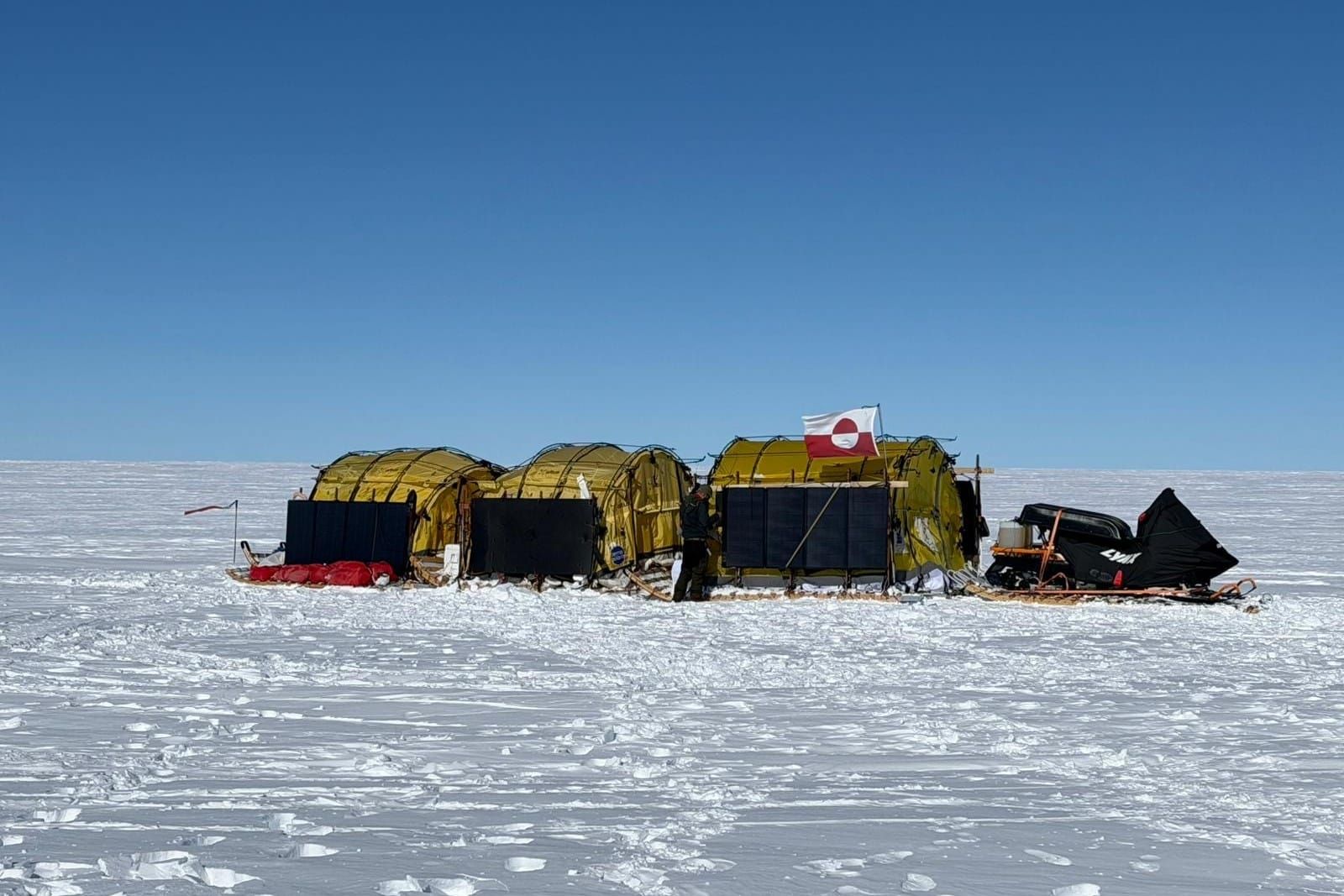
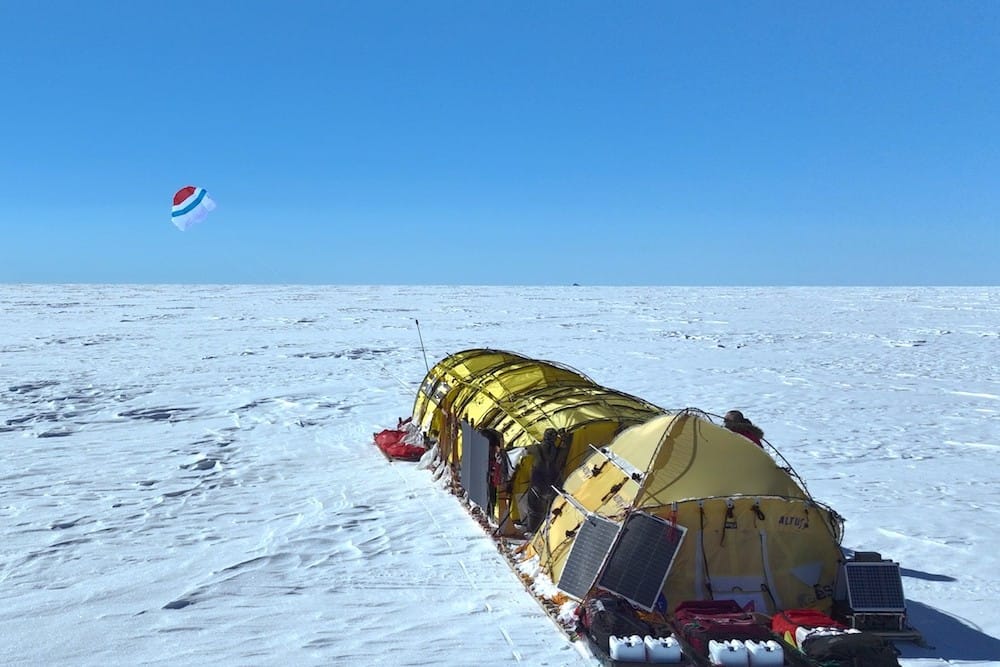
Ramón Larramendi has spent about 25 years working out how to travel across ice the way the Inuit did, and his answer is a sled that sails. Fifteen metres long, in four linked modules, it is pulled by kites, twenty of them, from a small five square metre sail to a 150 square metre giant, chosen to suit the wind of the day. Solar panels run the instruments. It can carry more than two tonnes, averages about 25 kilometres an hour and has touched 80 in a good blow. On 18 October Larramendi, polar guide Hilo Moreno, University of Maine researcher Mariusz Potocki and photographer Javier Selva left Spain for the Antarctic Wind Sled 2026 to 2027 expedition: roughly 3,400 kilometres in about 80 days, from near the Novolazarevskaya base in Queen Maud Land, across the Pole of Inaccessibility, past the Pole of Cold, to the Franco Italian Concordia station at Dome C. For comparison, the last scientific crossing of similar distance, in 2011 and 2012, used tracked trucks and about 170,000 litres of fuel. This one uses wind.
Along the way the four will set up five science camps for sixteen projects chosen by the Spanish Polar Committee, with CSIC, CIEMAT, INTA, six Spanish universities and partners abroad. Glaciologist Francisco Navarro of the Polytechnic University of Madrid will run ground radar through the top ten metres of snow to sharpen estimates of how Antarctica's ice is changing. A NASA Ames team led by Alfonso Dávila will test whether microbes could live inside salt rocks, a question with Mars in mind. Others will sample microplastics, measure Earth's magnetism and check how Europe's Galileo satellites perform at the bottom of the world, and Gabriel G. de la Torre of the University of Cádiz will study the crew themselves through 85 days of isolation, for the sake of future long space missions. At Concordia the people fly out, the samples go home with French help and the sled is packed away for a possible return crossing. This expedition is part of Spain's fortieth Antarctic campaign, and the journey can be followed live on the Trineo de Viento website.
Sources and links
Our short take: the full story is by Rafael Salido for Euronews (16 October 2026).
- A kite powered snow sled designed in Spain is gliding across Antarctica, by Rafael Salido, Euronews The sled, the route, the team, the sixteen projects.
- Trineo de Viento, the expedition's own site Live tracking of the crossing.