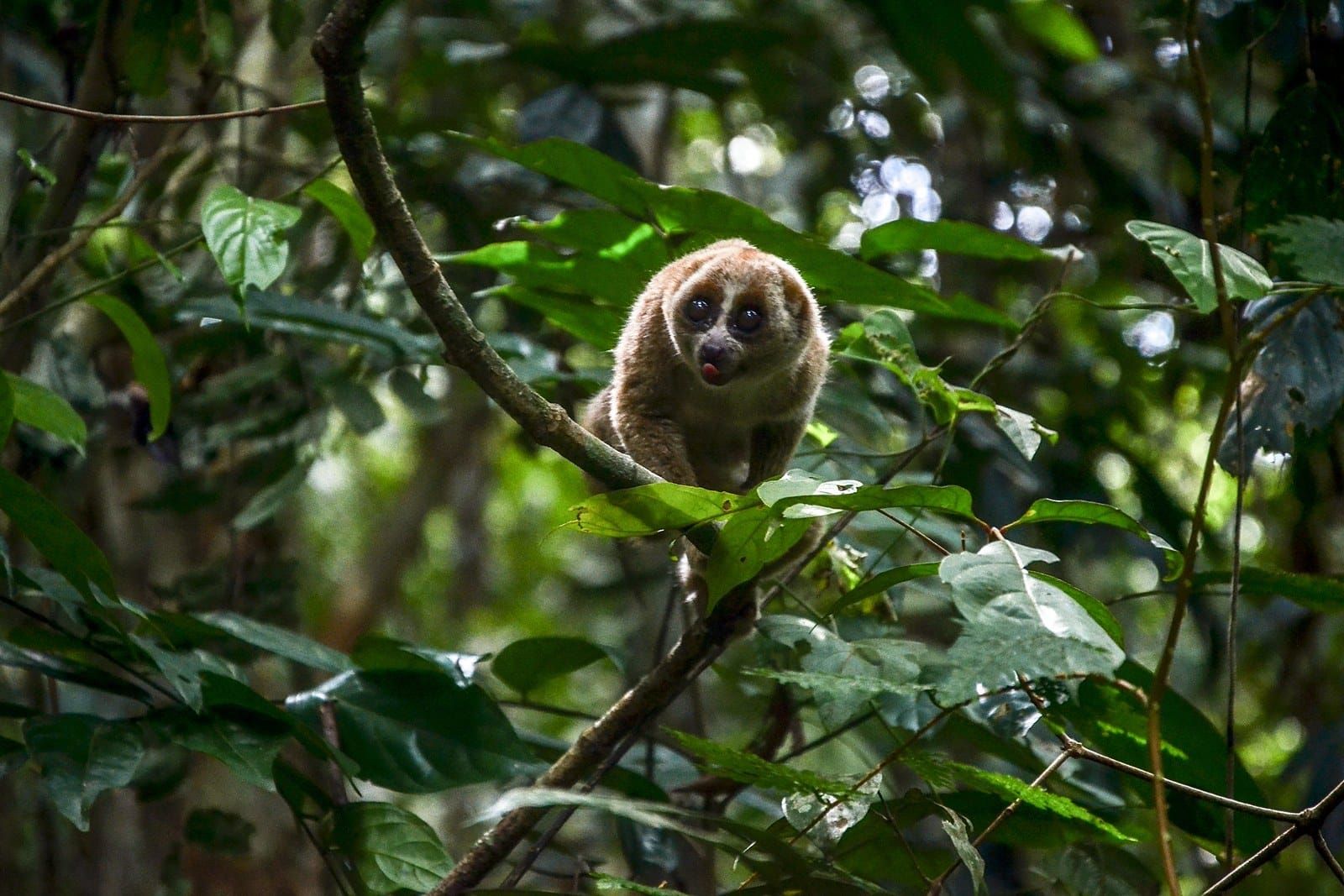
On Bangka, an island off the south east coast of Sumatra in Indonesia, about an hour's flight from Jakarta, a small primate with reddish brown fur and large round eyes has been living alongside people all along. Science had not reliably recorded the Bangka slow loris, Nycticebus bancanus, since specimens gathered between 1930 and 1932, and it sat on Re:wild's list of lost primates. In October a paper in the journal Spixiana showed it is very much here, thanks to the Alobi Wildlife Rescue Center, a local conservation group led by its director, Langka Sani. Since 2015 the Alobi team has cared for more than 90 Bangka slow lorises, found by residents in houses and gardens, on plantations and roads, all over the island. Once well, 86 of them went home to the forest, to places such as Bukit Mangkol and Gunung Menumbing forest parks and Gunung Maras National Park.
Five people wrote the paper: Langka Sani, Endi Riadi and Andre Septian of Alobi, Jochen Menner of the Taman Safari Prigen Conservation Breeding Ark in East Java, and Timon Glaw, a graduate student in nature conservation and biodiversity management at the Haus des Meeres Aqua Terra Zoo in Vienna. Glaw told Reuters the Bangka slow loris "is still alive," and that "every species is the result of millions of years of evolution and part of a complex ecological network." People on Bangka are adding to the picture too, with photographs of wild lorises shared on iNaturalist since 2023. Next come field surveys to learn where they live and how many there are, and the authors hope for a conservation programme on Bangka to care for its forests, with a breeding programme beside it.
Sources and links
An Earth to Sea News story, built mainly on Reuters (Will Dunham, 20 October 2026) and the paper in Spixiana, with Mongabay Indonesia. Photographs: as credited in captions.
- Reuters wire copy via Daily Maverick, Feared extinct, Bangka slow loris primate rediscovered in Indonesia, by Will Dunham, edited by Rosalba O'Brien
- Spixiana paper, Neglected but still alive: Further evidence for the continued existence of the Bangka Slow Loris (Nycticebus bancanus) on Bangka Island, Indonesia
- Mongabay Indonesia, Hampir 9 dekade hilang dalam literatur ilmiah, kukang Bangka masih ada di habitatnya, by Nuswantoro (25 Oct 2026)