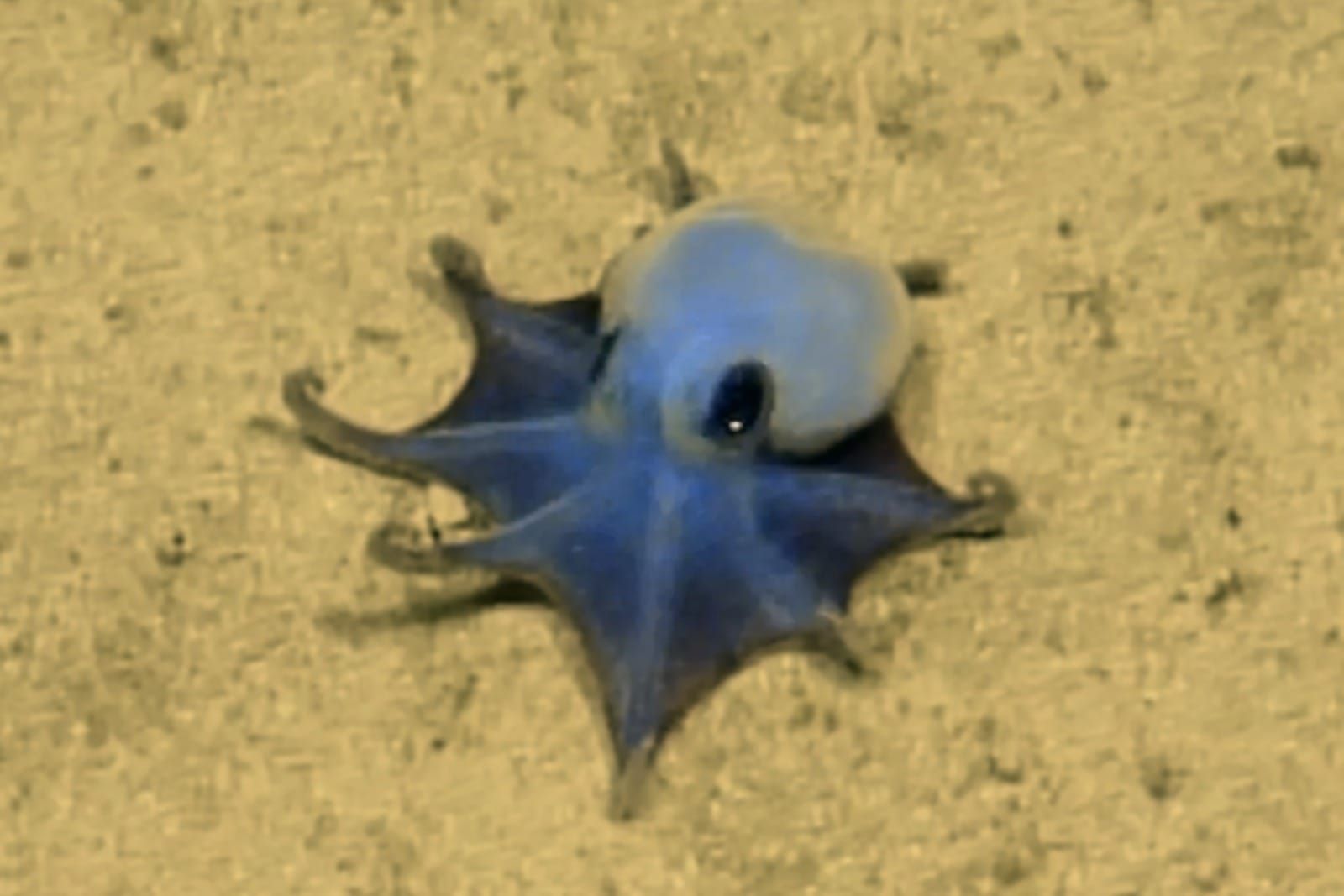
It was July 2015 and the exploration ship Nautilus was working the far north of the Galapagos Marine Reserve with the Charles Darwin Foundation and the Galapagos National Park. Its robot, Hercules, was gliding over a seamount beside Darwin Island, 1,773 metres down, when something came into the lights. "He's tiny!" someone said on the live feed. "It's blue!" An octopus with a pale blue back, a deep purple underside, huge eyes and short stubby arms was crossing the sand, no bigger than a golf ball, "like one of those plushies that kids put on their backpacks," as one researcher said. Before the dive was done they had filmed two more the same size. A photograph went to Janet Voight, curator emerita of invertebrates at Chicago's Field Museum and one of the world's octopus specialists. "Right away, I knew it was something really special," she said. "I'd never seen anything like it."
It took eleven years to be sure. Most octopuses carry two rows of suckers down each arm; this one has a single row, and smooth skin along its back, and no known relative in those waters. On 24 May this year, in the journal Zootaxa, Voight and her colleagues gave it a name, Microeledone galapagensis, the little Galapagos octopus. What makes the naming unusual is how it was done. Because there is only one of this octopus in the world's collections, Voight worked with Stephanie Smith, who runs the Field Museum's X ray lab, to study it whole: a micro CT scanner took thousands of X ray slices and built them into a 3D model, inside and out, the first octopus ever described that way. "There's nothing like spending the day looking at something no other human has ever seen," Smith said. Alexander Ziegler of the University of Bonn and Salome Buglass, formerly of the Charles Darwin Foundation, now at UCLA, shared the work. Voight thinks the colours help it keep safe in the dark. Darwin Island's seamounts have barely been looked at, and this little blue traveller is a reminder of how much is still down there waiting to be met.
Sources and links
Our short take: the story is from the Field Museum's own announcement (24 May 2026), with reporting by Gennaro Tomma for Science News (5 June 2026) and Frederic Bourigault for AFP (26 May 2026). Photograph: Charles Darwin Foundation, from the 2015 Nautilus dive,.
- This newly discovered blue octopus from the Galapagos Islands could curl up in the palm of your hand, Field Museum The announcement, Voight and Smith's quotes, the CT method.
- This tiny, blue octopus is new to science, by Gennaro Tomma, Science News Size, depth, the scan.
- Charles Darwin Foundation The Galapagos partner and the photograph.
- Ocean Exploration Trust, Nautilus Live The ship and the dive.