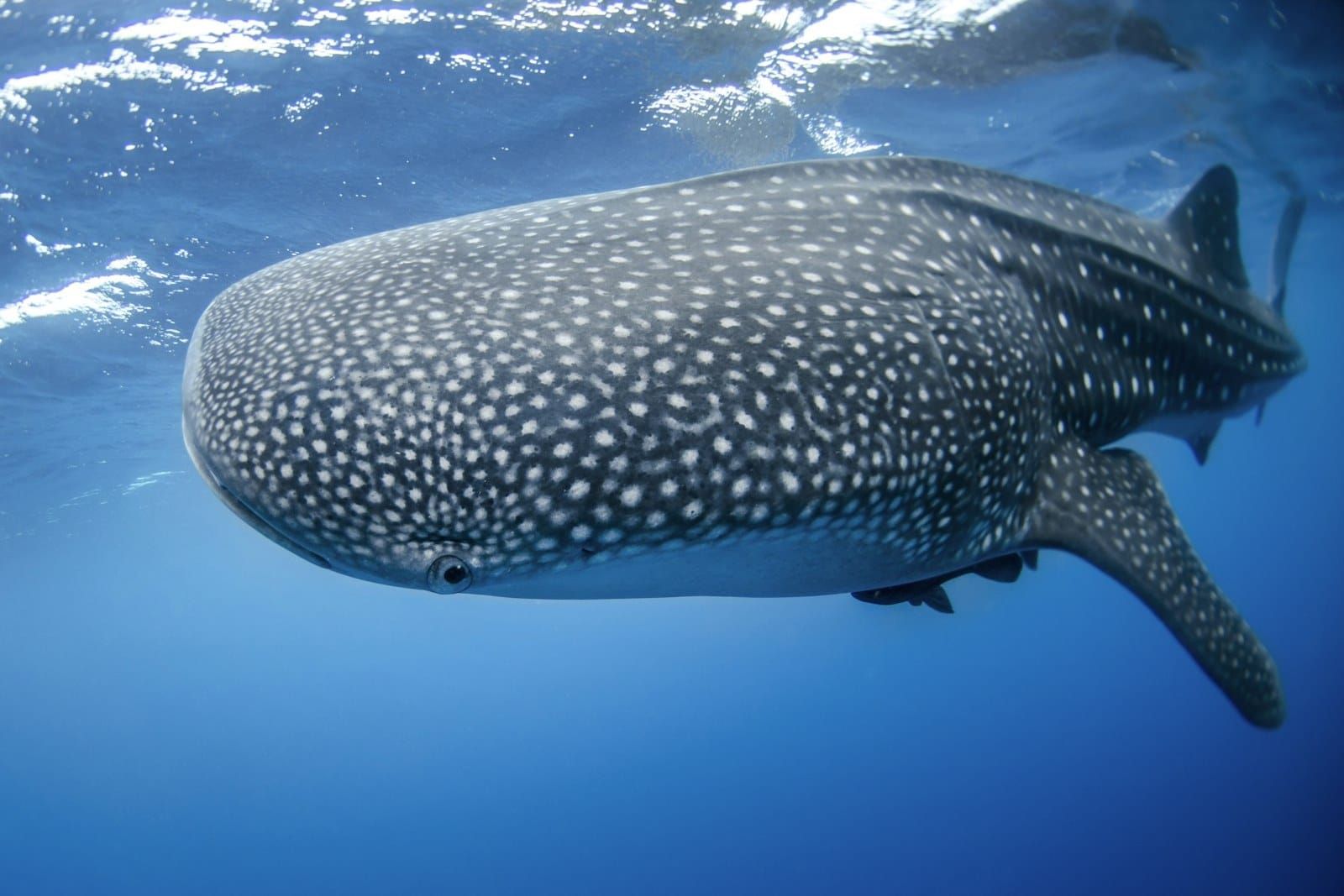
Whale sharks are fish, not whales, and at up to twelve metres they are the largest fish alive, filter feeding on plankton with a mouth wide enough to swallow a doorway and no interest at all in anything bigger than a shrimp. Every winter young ones gather in the warm shallows of the Bay of La Paz, at the southern end of Mexico's Gulf of California, and the season that closed on 30 April 2026 was a good one. Whale Shark Mexico, the La Paz research group led by Dr Deni Ramirez Macias, photographs the pattern of spots behind each animal's gills, as individual as a fingerprint, and its catalogue for the season records 56 different sharks, 950 sightings, and 20 juveniles never seen in the bay before. Eleven were still cruising the shallows when the season ended, in no hurry to leave.
What makes La Paz worth writing about is not just the sharks but the rules. Watching them is run by the national protected areas commission, CONANP, inside a refuge zone in the bay, and the season does not open on a date. It opens when the sharks say so: boats go out at half capacity only after six sharks have been counted on three days running, full capacity after ten, and if the count drops below six the bay closes again until they return. Boats are capped for the day and split into shifts, a few swimmers and a certified guide go in at a time, no one touches, and the animals set the distance. Milena Quiroga Romero, the mayor of La Paz, calls the whale shark one of the city's great environmental and tourism symbols and says the point is to keep it that way. From 1 October the new season can open, whenever the first six arrive, and we will be there in December with a mask and a very quiet snorkel.
Sources and links
Our short take: the season figures are from HOY BCS (13 May 2026, staff report) citing Whale Shark Mexico and CONANP; the opening rules are from CONANP's management plan for the bay, valid for the 2025 to 2028 seasons. Photograph: a whale shark in the Bay of La Paz, Baja California Sur, by Diego Delso, via Wikimedia Commons under CC BY-SA 4.0.
- Concluye temporada de tiburon ballena, HOY BCS The season count (Spanish).
- Whale Shark Mexico Dr Deni Ramirez Macias and the photo identification work.
- Plan de Manejo Tipo, tiburon ballena, Bahia de La Paz 2025 to 2026, CONANP The rules for the bay (Spanish, PDF).