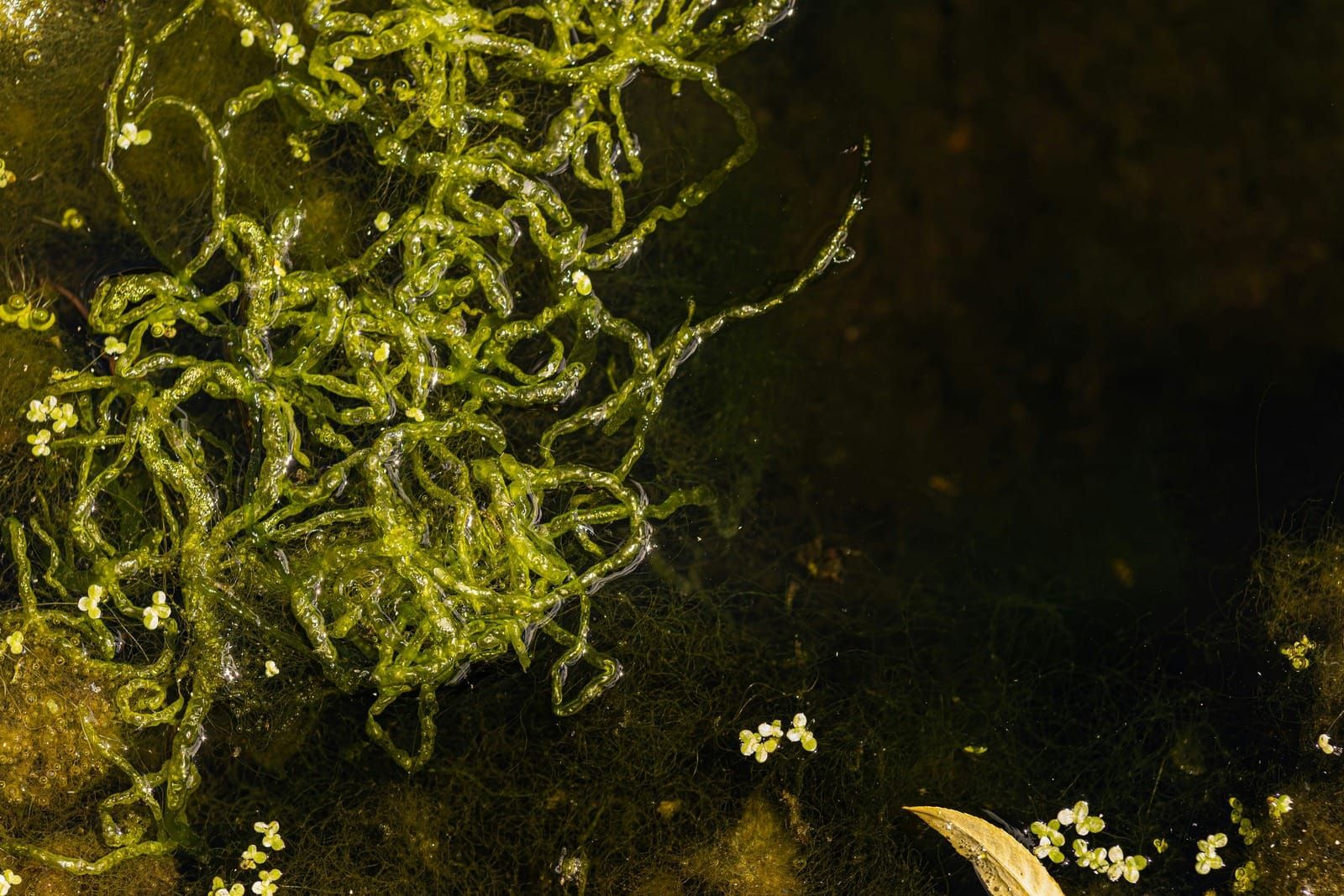
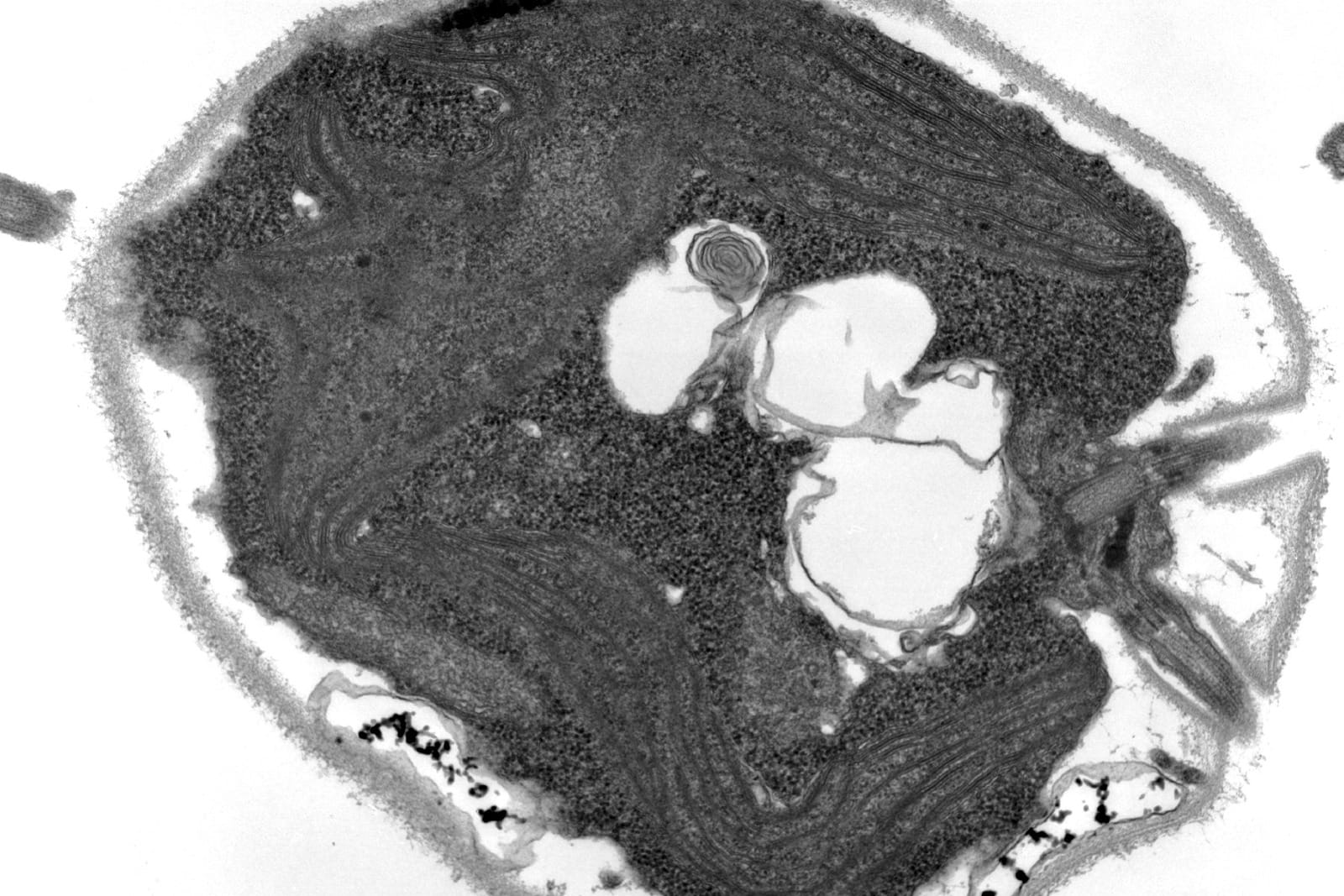
Chlamydomonas is a green alga a hundredth of a millimetre long, and it has one famous trick: stir it into a dish of water, shine a lamp on one side, and the faint green haze drifts toward the light. A tiny orange eyespot does the seeing. In the early 1990s Peter Hegemann measured how fast that eyespot answers light and found an electrical signal in half a millisecond, twenty times quicker than a human eye manages. His explanation, that one protein must both catch the light and open a channel for charged ions, met years of scepticism, and the protein itself fell apart whenever anyone tried to isolate it. Around 2000, Japanese researchers published the alga's genes, and Hegemann spotted two likely candidates. He sent them to his friend Georg Nagel in Frankfurt, who grew the proteins in frog eggs and watched them open within a fifth of a millisecond of a flash. They named the protein channelrhodopsin and published in 2003. Hegemann still remembers the first reviewer's comment: "An ion channel from pond scum." And the Chlamydomonas community, he says, "was not amused." At Stanford a young psychiatrist, Karl Deisseroth, wrote to Nagel asking for the gene, put it into rat nerve cells in a dish, and in 2005 made them fire with a pulse of blue light; two years later it worked in a living brain. Per Svenningsson, chair of the Nobel Committee, said on 5 October: "Optogenetics provides opportunities for mapping the brain in a way that we could once only dream of."
Read the full story: A light sensitive algal protein energised neuroscience, by the Nobel Assembly at Karolinska Institutet, nobelprize.org.
What the three friends built is now in laboratories around the world, tracing the circuits behind memory, thirst, pain and attention. "We're not using light to collect information, we're using light to cause things to happen," Deisseroth told Annalisa Merelli of STAT. Then there is the eye. At the Institute of Molecular and Clinical Ophthalmology Basel, Bence György told the Swiss agency Keystone SDA on prize day that the award "is extremely important for Switzerland." In 2021 a Basel and Paris team gave a man of 58, blind for decades from retinitis pigmentosa, a light sensitive protein in the nerve cells of his retina and a pair of glasses that beam the world onto it in amber light. With the glasses on he could find and touch objects on a table, and in daily life make out a telephone, a door and a pedestrian crossing. "Perhaps this will eventually enable patients to recognize faces or read again," György said, adding plainly that the method still needs work. Nagel, reached on a sunny terrace in Italy among olive and lemon trees, was just as honest: "I didn't expect this, really," he said, because so far he knows of one patient who has benefited. Hegemann, asked what the young should do, said they "should not improve optogenetics. They should work on something new," because "there are so many interesting creatures you can study." Deisseroth agrees the prize "really captures the full journey of discovery," one that began with a speck of pond life turning toward the light.
Sources and links
Our short take: the full story is the Nobel Assembly at Karolinska Institutet's press release and popular science background (5 October 2026), with the Basel vision work from Keystone SDA via blue News (5 October 2026), the laureates' own words from the nobelprize.org first reaction interviews, Stanford Report and STAT (Annalisa Merelli, 5 October 2026).
- Press release, The Nobel Prize in Physiology or Medicine 2026, Nobel Assembly at Karolinska Institutet Laureates, citation, the alga, 2005 and 2007, Svenningsson's quote, the vision line.
- A light sensitive algal protein energised neuroscience, popular science background, Nobel Assembly at Karolinska Institutet Eyespot, half a millisecond, Martinsried, frog eggs, 0.2 milliseconds, 2003 paper, the heart and anxiety finding.
- Peter Hegemann, first reactions interview, Nobel Prize Outreach (Adam Smith) "An ion channel from pond scum", "not amused", advice to the young, the 1866 St Petersburg paper.
- Georg Nagel, first reactions interview, Nobel Prize Outreach (Adam Smith) "I didn't expect this, really", one patient, the terrace in Italy.
- Karl Deisseroth, first reactions interview, Nobel Prize Outreach (Adam Smith) Heart pacing and brain states, his patients.
- Basel researchers aim to restore sight to the blind using optogenetics, Keystone SDA via blue News Gyorgy's quotes, the 2021 patient (58, blind for decades), telephone, door, crossing.
- 2026 Nobel Prize in Medicine awarded for brain research tool called optogenetics, by Annalisa Merelli, STAT Deisseroth's "cause things to happen" quote. Open on 12 Oct, not STAT+.
- Karl Deisseroth awarded 2026 Nobel Prize in physiology or medicine, Stanford Report "full journey of discovery", his titles, the 12:27am call. No personal byline on the page; credit Stanford Report.
- Nobel Prize for Wurzburg Professor Georg Nagel, by Robert Emmerich, University of Wurzburg Nagel's career, Paul Pauli and Dirk Becker quotes, photo by Rudi Merkl.
- Humboldt University of Berlin press portal, October 2026 Hegemann's university. Page is live but sits behind a bot check, its text could not be read on 12 Oct.
- Gene therapy lets a blind man partially see again (German), University of Basel, 24 May 2021 Retinitis pigmentosa, amber light, the glasses, objects on the table, Roska and Sahel.
- Partial recovery of visual function in a blind patient after optogenetic therapy, Sahel et al, Nature Medicine 2021 The 2021 paper, open access.
- Institute of Molecular and Clinical Ophthalmology Basel (IOB) Gyorgy's institute. Use this address without www; the www version showed an expired certificate on 12 Oct.
- Stanford University Deisseroth's university.