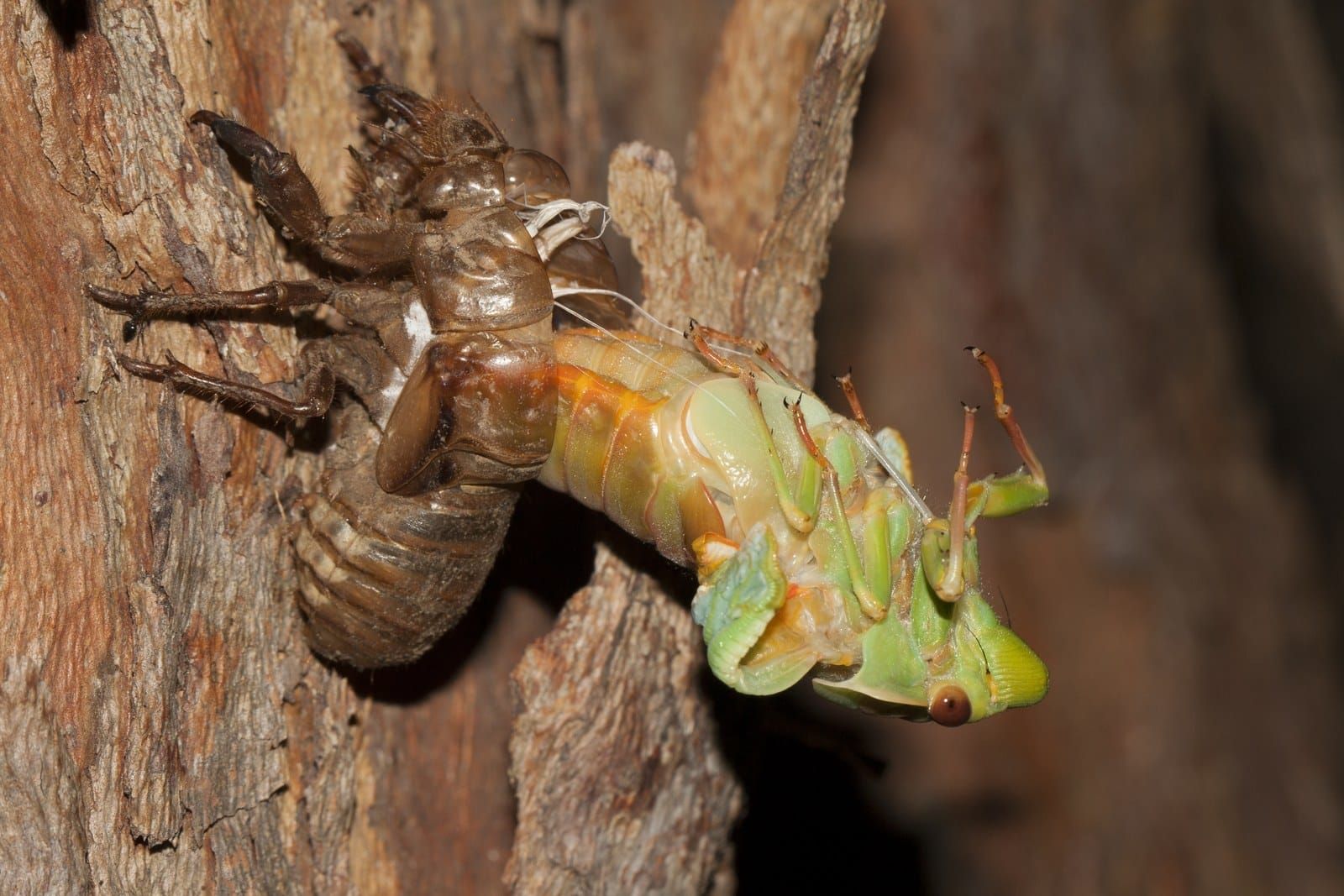
Somewhere under a Sydney garden this month, a cicada that has waited years is getting ready to climb. Green Grocer nymphs spend up to seven years in the soil, sipping sap from tree roots. Then, on a warm evening between September and November, often after rain, they dig up around nightfall and walk to the nearest trunk, post or fence. There each one holds tight and sheds its skin for the last time. A soft, pale adult eases free and unfolds its wings, and by morning only an empty brown shell is left, still gripping the bark. Above ground, the adult has about six weeks of summer. Only males sing: a pair of ribbed membranes called tymbals, at the base of the abdomen, buckle in and out, and his hollow abdomen carries each click out into song.
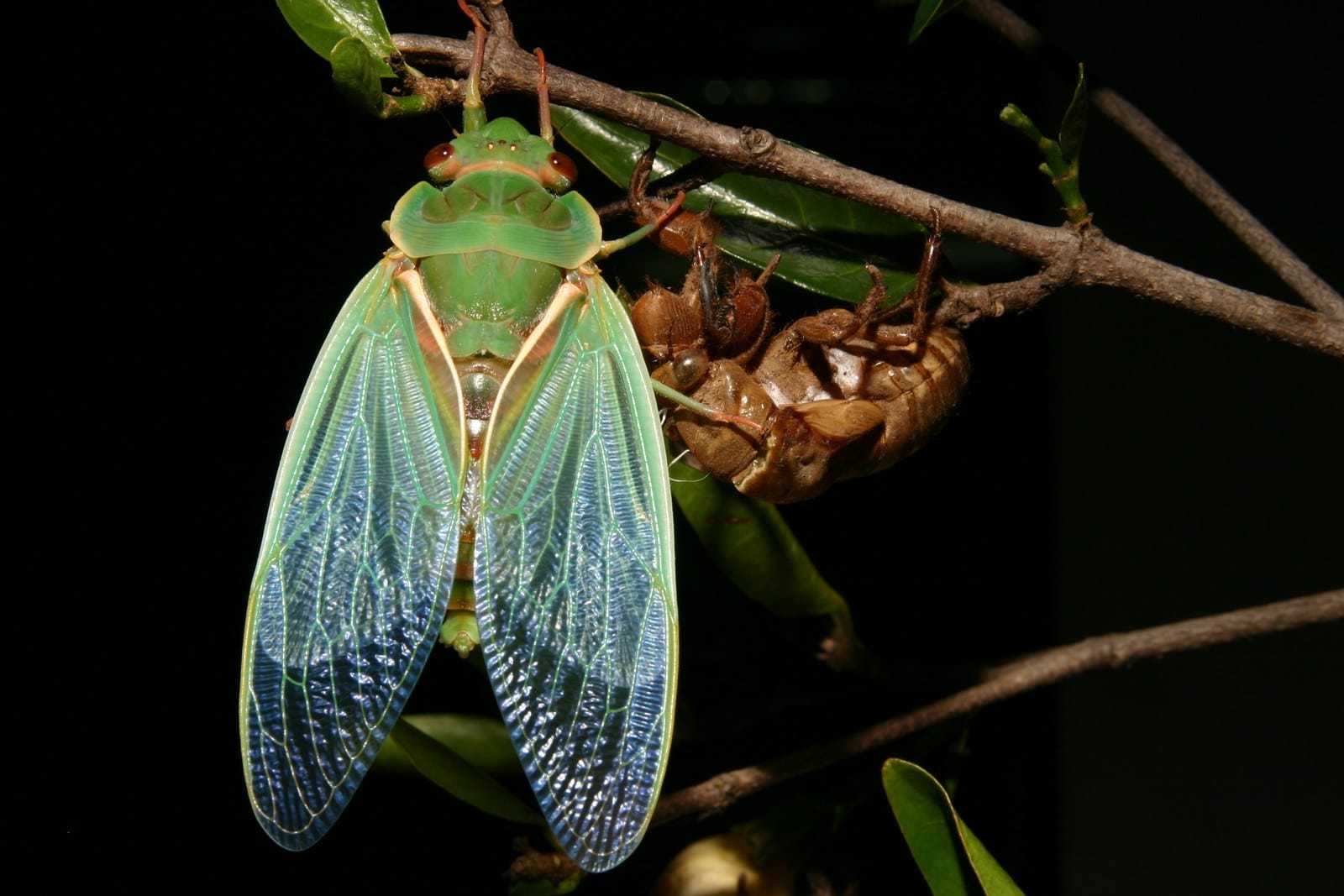
Every species has its own song, so each calls only to its own kind. Sydney's singers have wonderful names. Green Grocer and Yellow Monday are colour forms of one species, joined now and then by a rare Chocolate Soldier or Blue Moon. Then come Black Prince; Redeye, with bright red eyes; Floury Baker, named for the flour like dusting on a newly emerged adult; and Double Drummer, one of Australia's largest cicadas. Up close, Green Grocers and Double Drummers can pass 120 decibels, often singing together in chorus. Among many smaller Australian cicadas, a female answers with a quick flick of her wings. Once paired, she lays her eggs in slits in a branch, and about four months later tiny nymphs hatch, drop to the ground and burrow down to begin again. There is more to hear yet: this year Dr Lindsay Popple of the Queensland Museum described eight new Yoyetta cicadas, and Dr Max Moulds of the Australian Museum twelve new Tamasa. When the first evening chorus starts, it is the sound of a long journey arriving.
Sources and links
An Earth to Sea News story. Facts from the Australian Museum, Museums Victoria, The Conversation, PLOS ONE and Zootaxa. Photographs: as credited in captions.
- Australian Museum, cicadas
- Australian Museum, Greengrocer
- Australian Museum, Floury Baker
- Australian Museum, Double Drummer
- Museums Victoria, Redeye
- The Conversation, the sound of summer, by Eliza Middleton and Linda Evans (2021)
- PLOS ONE, how female cicadas answer with a wing flick, David C. Marshall and Kathy B. R. Hill (2009)
- Zootaxa, eight new species of Yoyetta, Lindsay W. Popple (March 2026)
- Zootaxa, twelve new species of Tamasa, Max S. Moulds (June 2026)