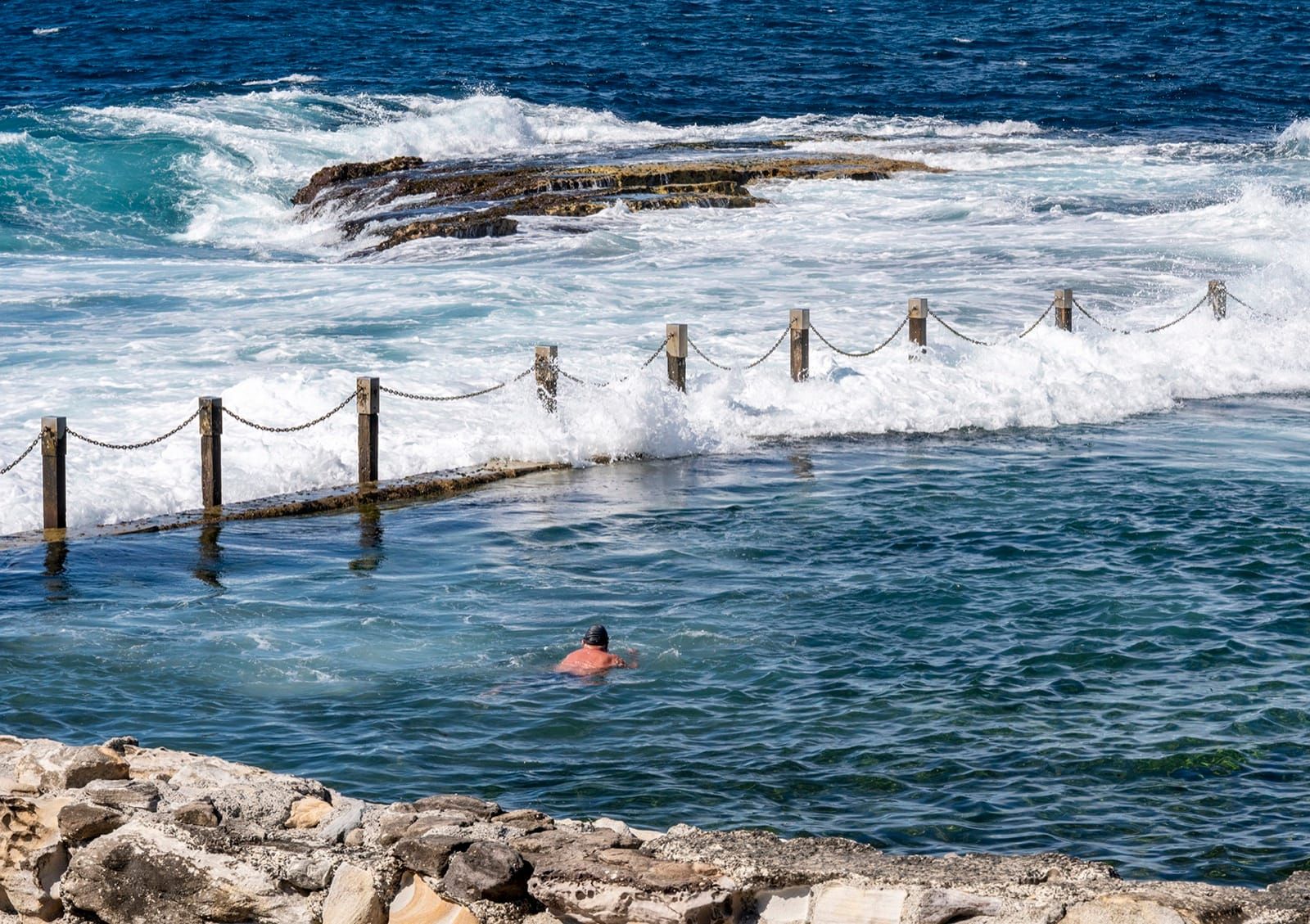
Under the cliff at the northern end of Maroubra Beach, below Jack Vanny Reserve, sits a pool that began as a hollow in the rock platform. Alderman Patrick Mahon put a petition to Randwick Council in the mid 1930s asking for sea baths there, and its walls were laid by local men who had lost their work in the Depression. He died in September 1935, before the pool was finished, and when it was completed in 1936 the Maroubra Bay Progress Association asked that it carry his name. Ninety years on it is still thirty metres of sea water with a sandy and rocky floor and an eastern wall the ocean comes over on any decent swell. Every Sunday from May to October the Maroubra Seals Winter Swimming Club, formed in April 1959, races here at nine in the morning, and the National Trust listed the pool in 1994 for the way it seems to melt into the rock platform. Council cleans it weekly with no chemicals at all, which is part of why it is so full of life.
Go on a low tide, when the eastern wall stands clear and the platform around it is open. Along the outer edge, cunjevoi (Pyura praeputialis) form a tough brown mat, and any you tread near squirt a small jet of water. In the crevices beside the steps, waratah anemones (Actinia tenebrosa) sit closed like dark red buttons until the water returns and they open. Neptune's necklace, the beaded brown seaweed Hormosira banksii, drapes the rock between the tide marks. Swift footed crabs (Leptograpsus variegatus), the busiest crab on Sydney's rocky coast, dart between the boulders. In the pool itself, a still moment at the shallow end shows you blennies flicking between the stones, sea hares grazing the green film on the walls, and short spined sea urchins (Heliocidaris erythrogramma) tucked into the folds of the floor. Underwater, luderick, the striped grazing fish of Sydney's reefs, cruise the deeper corners, while beyond the wall the eastern blue groper, fish emblem of New South Wales since 1996, drifts past in cobalt blue. Fully protected from fishing in New South Wales since March 2024, with the protection extended to 2028, the groper remains one of our favourite labradors of the sea: the friendliest of the wrasses, and in protected waters especially, curious and interactive. Our beautiful blue groper enjoys coming to say hello and loves making new friendships. Octopus, too: the common Sydney octopus (Octopus tetricus) lives on intertidal rocky shores like this one, and as ocean pool historian Marie Louise McDermott told the ABC, "there are people that become quite fond of octopus at their local ocean pool."
Ocean pools are free, open at all hours and belong to everyone. Sydney Swans players train here and the Seals keep their clubhouse on the cliff above, and on a weekday morning you may share the water with three swimmers and a great many smaller locals. Take a low tide and an hour, and look before you swim. Then send us a photo of what lives in your local pool, wherever in the world it is, at earthtoseanews@gmail.com, and we will share the best of them.
Sources and links
Our short take: the pool's history is from Randwick City Council's Mahon Pool page and the Coogee Media history of the pool; the Seals' story is from the Winter Swimming Association of Australia and Maroubra Surf Life Saving Club; every species is confirmed against the Australian Museum's rock platform pages and the NSW Department of Primary Industries' Cabbage Tree Bay rock platform guide; Marie Louise McDermott's words are from Sue Daniel's Curious Sydney piece for ABC News. Photo: Oliver Strewe.
- Mahon Pool, Randwick City Council Patrick Mahon's petition, Depression era labour, completed 1936, Mahon Memorial Pool, weekly clean with no chemicals, Sydney Swans training venue.
- Mahon Pool, Coogee Media Local history page: Patrick Mahon died 3 September 1935 aged 43, cites the Sydney Morning Herald of 4 September 1935 and Nicole Larkin for the National Trust.
- Heritage ocean pools to visit this summer, by Charlotte Anlezark, National Trust NSW, 20 December 2022 National Trust listing 1994, "melt into the rock platform".
- Maroubra's Mahon Pool amenities building opens ahead of busy summer, Randwick City Council, 13 September 2019 Mayor Kathy Neilson; Seals racing here on Sunday mornings since 1959; the clubhouse on the cliff.
- Maroubra Seals, Winter Swimming Association of Australia Club formed at a meeting on 7 April 1959; Council permission for Sunday races at Mahon Pool.
- Maroubra Seals Winter Swimming Club, Maroubra SLSC Meets every Sunday at 9am, May to October, at Mahon Pool.
- Why Sydney's unique ocean pools are the envy of other Australian cities, by Sue Daniel, ABC News Curious Sydney, 7 June 2018 Marie Louise McDermott on Depression era pools and the octopus line, quoted verbatim.
- Waratah Anemone, Australian Museum Actinia tenebrosa, "the most noticeable species of anemone on Sydney's rocky shores"; closed red blob at low tide.
- Cunjevoi, Australian Museum Pyura praeputialis, intertidal rocky shores, mats at the low tide mark, squirts when trodden near.
- Swift footed Crab, Australian Museum Leptograpsus variegatus, "the most active and prominent crab on Sydney's rocky coast", purple and white claws.
- Sea Hare, Australian Museum Sea hares live on intertidal rocky shores and in rock pools; several species around Sydney.
- Common Sydney Octopus, Australian Museum Octopus tetricus, found on intertidal rocky shores and in the ocean.
- Eastern Jumping Blenny, Australian Museum Inshore rocky reefs and tidepools, Queensland to Victoria.
- Luderick, Australian Museum Girella tricuspidata, coastal waters and shallow rocky reefs, larvae in rock pools.
- Eastern Blue Groper, Australian Museum Achoerodus viridis, rocky coastal reefs from shallow water, fish emblem of New South Wales in 1996, males deep navy to cobalt blue.
- The sea urchins of Sydney, by Emily McLaren, Australian Museum, 26 June 2023 Heliocidaris erythrogramma on intertidal and shallow reefs.
- Cunjevoi habitat, Cabbage Tree Bay Aquatic Reserve, NSW Department of Primary Industries Sydney rock platform guide naming Neptune's necklace, anemones, blennies and threefins in the cunjevoi zone.
- Mahon Pool, Maroubra, Ocean Pools NSW Swimmer's account: the Seals pointing out sea urchins on the pool floor, the sandy and rocky floor, no lane markings.
- Mahon Pool on our Places to Explore map Our place card, with the facts for a visit.