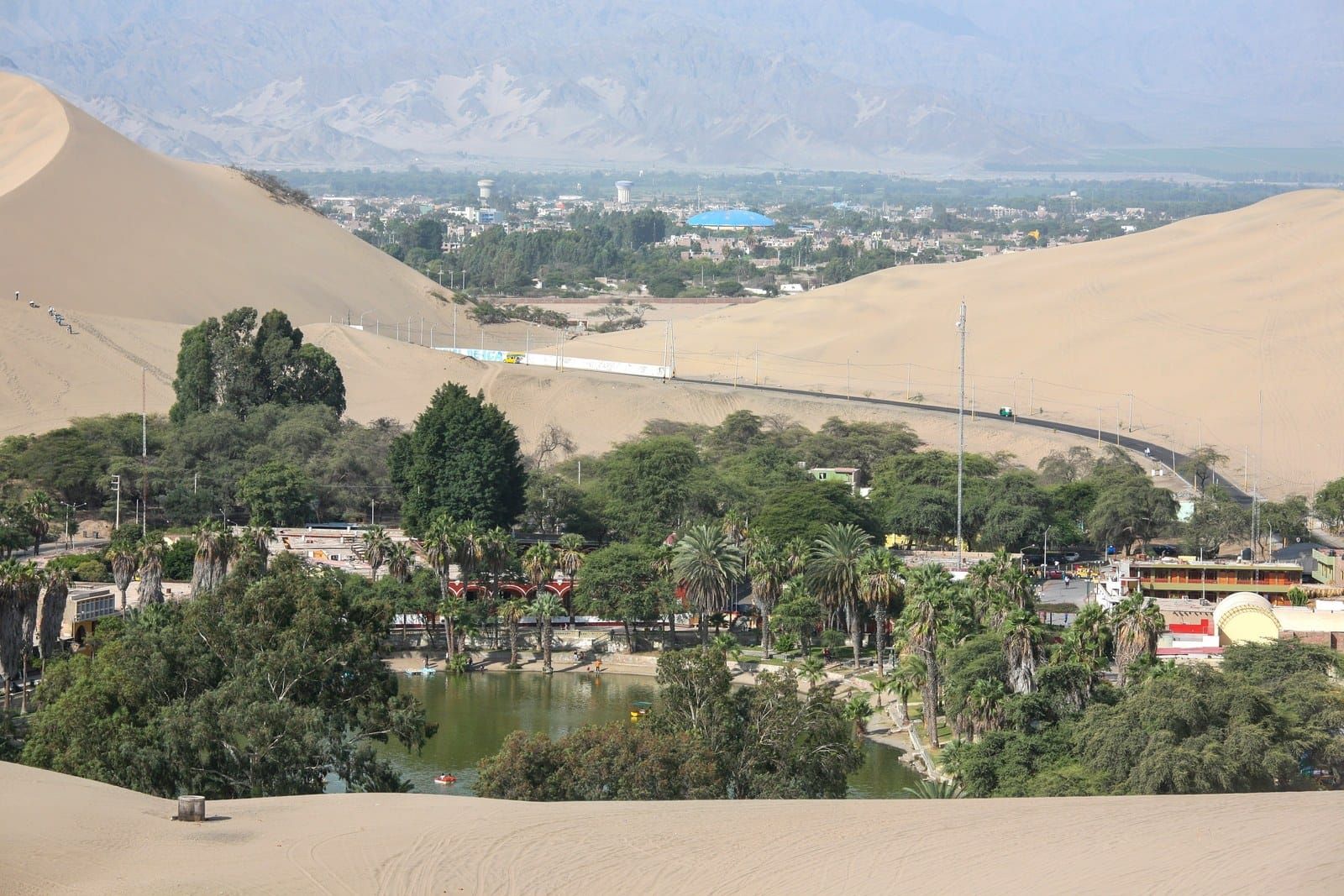
Huacachina sits in a bowl of dunes a few kilometres from the city of Ica, in the coastal desert of southern Peru: a small green lagoon ringed by palms and huarango trees, a village of a few hundred people, and sand rising a hundred metres on every side. Legend says a princess bathing by a huarango fled a hunter across the dunes, her mirror shattering into the lagoon and her trailing cloak becoming the sand. Since 2014 the lagoon and 2,407 hectares around it have been a regional conservation area, run by the regional government of Ica with Peru's park service, SERNANP, as adviser, protecting the huarango, tonuz and espino trees and an endemic sand lizard. As farms drew on the aquifer the lagoon fell, so the regional natural resources office now tops it up from a well with about 15,000 cubic metres of water a month and reads a gauge on the shore. Ana de los Angeles Munares Yauri, who leads that office, told the Andina news agency the level had risen fifteen centimetres and the well's own water table had held.
This year the looking after has new hands. In August a management committee led by local people took over, with Maria Elena Cabrera Maya, a tourism professional from the Ica photographers' association, as president and Joel Huamani of the Ica Chamber of Commerce as her deputy, and the small entry fee going to conservation, security and cleaning; Cabrera Maya calls the committee the body that watches over Huacachina's future, Diario Correo reported. On 9 September the regional government approved a plan for the area to 2031 with three aims: its wildlife, its water balance and tourism that lasts. And the trees are coming back. Marina Audich has coordinated Amigos del Arbol since 1993 and is credited with about 97,000 huarangos planted at the Golden Meier forest at Guadalupe, which this month made her a national finalist in the Peruanos que Suman awards, Gonzalo Felix reported in La Opinion. Every third Friday of April the city holds a huarango festival, founded in 2006 by the Kew botanist Oliver Whaley and Alberto Benavides Ganoza. An hour north, the Paracas National Reserve turned fifty last year.
Sources and links
Our short take: the conservation area from Peru's environment ministry (2014) and the SPDA's Actualidad Ambiental; the water figures from the Andina news agency (April 2024); the committee from Diario Correo (24 August 2026); the master plan from the regional government of Ica's ordinance of 9 September 2026 and Jose Chacaliaza Ramos in Diario Correo; the huarango planting from Gonzalo Felix in La Opinion (30 September 2026); the legend from iPeru. All in Spanish.
- La Huacachina se convierte en area de conservacion regional, Ministerio del Ambiente, 7 August 2014 The designation.
- Laguna Huacachina mantiene su nivel gracias a recarga permanente de agua, Andina, 15 April 2024 The monthly top up, Munares Yauri.
- Nuevo comite de gestion de Huacachina, Diario Correo, 24 August 2026 The committee and its president.
- Ica fortalece conservacion de Huacachina, by Jose Chacaliaza Ramos, Diario Correo, 9 April 2026 The plan presented.
- Guardiana del Huarango de Ica, by Gonzalo Felix, La Opinion, 30 September 2026 Marina Audich and the 97,000 trees.
- La sirena de la laguna Huacachina, iPeru The legend.
- Reserva Nacional de Paracas at 50, Inforegion, 18 September 2025 The reserve next door.